01 / Learn
Understand the whole funnel
Start with the business model, customer journey and the metrics that connect activity to outcomes.
Growth marketing resources / Learn · Practise · Build proof
Use these growth marketing resources to move beyond channel tasks. Learn to connect business goals, customer behaviour and experiments — then show the thinking in your own work.
Start with the Growth Skills Scorecard
Ten scenario questions across five growth skills. Get your score, two learning priorities and a four-week roadmap matched to your available study time.
Answer the questions, review your result, then request your roadmap and Starter Kit by email.
A practical learning guide, not a professional certification. Your request does not subscribe you to marketing emails.
Build on marketing fundamentals. Use evidence, and label assumptions clearly.
Start with the business model, customer journey and the metrics that connect activity to outcomes.
Use the free kit to audit a funnel, prioritise a problem and write an experiment brief.
Turn the work into a case study with context, evidence, a recommendation and honest limitations.
Free / Remote Growth Manager Starter Kit
A 90-minute practice route to turn growth concepts into a clear next step.
A framework and fictional worked example to make the thinking concrete.
Put your diagnosis and priorities into a format you can work with.
Support your practice, reflection and weekly update.
Complete the request form. After a successful submission, your download links appear below.
One resource request. No automatic newsletter subscription.
The worked example is fictional. Label assumptions and practice work clearly in your portfolio.
Your next step / Growth OS
Explore the Growth Manager OS preview when you’re ready to connect priorities, experiments and weekly learning in a wider workflow.
Career resources
Remote work: practical lessons for marketers
Share feedback after trying the kit
Mentoring is a future offering. No booking or payment is available here.
Put the resources to work
Pick a product you understand and one customer goal. Map the steps between discovering the product and reaching that goal. Keep the first exercise small: an onboarding flow, a first purchase or a return visit is enough.
These growth marketing resources help you structure the exercise. They do not replace customer research or access to reliable data. If you use a public product, write down what you can observe directly and what remains an assumption.
Start with a decision, such as which part of onboarding deserves investigation. Define what successful activation means for the customer, then identify the events that would help answer the question. A sign-up is not automatically evidence that someone received value.
For a measurement reference, read the official PostHog guide to funnels. You can practise the logic in a spreadsheet before selecting an analytics tool. The important skill is connecting the metric to a real customer action.
Describe the problem, the proposed change and the reason you expect it to help. Name the primary outcome, a guardrail and the point at which you will review the result. Avoid changing several unrelated things in a first practice experiment.
Use the templates within these growth marketing resources to make your reasoning visible. A useful brief explains uncertainty as clearly as it explains the idea. If you cannot run the test, label it as a proposed experiment rather than an achieved result.
A portfolio case should tell the reader what problem you chose, what evidence you had, what you recommended and why. Include alternatives you considered and constraints that affected your decision. This shows judgment more clearly than a collection of attractive dashboards.
Keep fictional examples separate from employment or client work. Never invent conversion improvements, customer research or revenue results. Growth marketing resources can support a practice case; they cannot turn assumptions into real business outcomes.
End each exercise with a short reflection. Explain what you learned, what you still do not know and which question you would investigate next. If new information contradicts your first idea, update the recommendation and show your reasoning.
Revisit these growth marketing resources as your questions become more specific. You do not need to read everything before starting. One complete, honest exercise is a better foundation than an unfinished folder of frameworks.
They are intended for marketers who want to move beyond channel execution and understand the wider customer journey. They can also help career changers practise business framing, measurement and experiment design. Start with the roadmap if the terminology is unfamiliar, then complete one small exercise.
The Starter Kit is offered as a free resource request. The Growth Manager OS link opens its preview. Each destination explains what is available there. Mentoring is a future offering and is not available to book or purchase on this page.
Yes, use the structure to explain your own thinking. Clearly identify practice work, fictional data and untested recommendations. Credit any source material and avoid sharing confidential employer or client information. The strongest case is one you can explain and defend in your own words.
Further reading
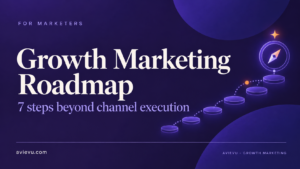
Choose the skills and questions to work on next.
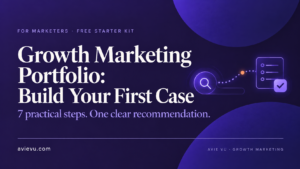
Show context, evidence and honest limitations.

Explore the habits behind clear remote collaboration.

Your collaborator
I connect growth marketing, CRM and user experience to help teams understand where customers get stuck and decide what to improve next.
Choose a product and describe its audience in one sentence. Write down the customer’s immediate goal, the product’s business model and the action that connects the two. Then sketch the main steps in the journey. Keep the scope narrow enough that you can explain every step without using a large diagram.
Use the roadmap and growth marketing resources to check your vocabulary, but make your own choices. Record which details came from public observation and which details you inferred. If a step is hidden behind an account or payment, note that limitation instead of pretending you have inspected it.
Look for a mismatch between what the customer expects and what the journey asks them to do. Examples might include an unclear next step, missing reassurance or a message that arrives before it is useful. These are possible problems to investigate, not established causes of poor conversion.
Choose one question that can guide the rest of the session. Explain why it matters to the customer and to the business. The worksheets in these growth marketing resources are there to help you express that reasoning, rather than encourage you to fill every box with an answer you cannot support.
State that limitation at the beginning. You can still create a journey review, identify research questions and propose an event measurement plan. You can also use fictional numbers to demonstrate a calculation, provided every table and result clearly says it is a simulated exercise.
Do not present a simulated conversion lift as a client result. Instead, explain which data you would need, how you would check its quality and what evidence would change your recommendation. Growth marketing resources are most valuable when they make your uncertainty easier to discuss.
Use a short case structure: context, question, available evidence, hypothesis, proposed test and limitations. Show the most relevant supporting material and remove screenshots that do not help the reader assess your reasoning. A concise case can communicate more than a long presentation full of unexplained charts.
End with the next decision you would make if the proposed test succeeds, fails or produces an unclear result. This demonstrates that you see experimentation as a learning process. Refer to the portfolio guide among these growth marketing resources when you are ready to turn the exercise into a shareable case.
Repeat the exercise with a different customer journey, or improve the first case using feedback. Keep a small record of the questions you can now answer and the ones that still feel difficult. Choose your next reading based on those gaps.
You can return to these growth marketing resources for measurement, career direction or portfolio structure. Progress comes from applying ideas and reviewing your reasoning over time, rather than completing a fixed number of articles.