Remote work in 2026 deserves a more useful conversation than another argument about where people sit. For marketers, the practical question is how to show that you can understand a business, choose a sensible priority and keep work moving across time zones.
There is a timely reason to revisit this. As checked on 8 October, WFH Research is announcing the 2026 Remote Work Conference for 28–30 October at Stanford University. Its ongoing research brings working arrangements back into focus. This is a research event announcement, not evidence of a new global hiring boom.
My view: the strongest preparation for a remote marketing role is a small, clear example of how you think and deliver. A long software list becomes more convincing when someone can see the business decision behind it.
Remote work in 2026: what the October research context tells us
The upcoming conference shows that remote work remains an active research topic. WFH Research also maintains survey results and a publication archive. You can follow the conference announcement and working-arrangements updates and the research archive directly.
The distinction matters: research about how people work is different from evidence about which employers are hiring. A survey cannot tell you whether a particular company accepts applications from Vietnam, offers flexible overlap hours or engages international contractors.
When reading headlines about remote work in 2026, check three things before drawing a career conclusion: the publication date, the geography and the population measured. An employer survey, a job-board dataset and a survey of existing workers answer different questions.
For an actual application, the job description and employer’s written clarification matter more than a general market headline. Keep a small shortlist of roles where the location, responsibilities and working arrangement fit. That gives your preparation a concrete target.
5 practical lessons for marketers preparing for remote work in 2026
1. Show the decision behind your campaign
Instead of saying that you managed content, explain the business problem, the audience, the action you wanted and how you assessed the outcome. What made this campaign worth running? What did you learn that changed the next decision?
If a campaign generated signups but few paying customers, explain how you investigated that gap. Be precise about what you owned and what colleagues delivered. A hiring manager should be able to separate your contribution from the team’s overall result.
2. Make your work easy to review asynchronously
A useful update answers four questions: what changed, what it might mean, what happens next and what needs a decision. Link the evidence and name the owner. Your teammate should understand the situation without waiting for a meeting.
Clear writing is a practical skill for remote work in 2026. It reduces the amount of context colleagues need to reconstruct. When uncertainty remains, state it directly: “The sample is too small to choose a winner” is more useful than presenting a weak signal as success.
3. Connect acquisition to first value
Clicks and signups show where interest begins. They do not establish that people received value. Define the first meaningful product outcome and inspect the journey towards it.
For a money-transfer product, approval and a completed first transfer are different milestones. For a learning product, an account and a completed first lesson are different milestones. Read the gap between approval and first transfer for a practical example of diagnosing the next step.
4. Check the working arrangement before applying
Remote can mean within one country, across selected regions or with fixed overlap hours. Ask what hours require live collaboration, how success is reviewed and which decisions you can make independently.
For remote work in 2026, a useful question is: “What would you expect me to understand, deliver and improve in my first month?” The answer can reveal whether the role is mainly campaign execution, marketing operations or broader growth ownership.
5. Build one honest practice case
You do not need confidential employer data to demonstrate judgement. Choose a fictional product, label the assumptions and show your calculations. Explain what you would investigate before spending money.
A practice case should remain clearly identified as practice. Do not present simulated conversion improvements as client results. Its purpose is to make your reasoning visible, including the evidence you still need.
What a useful remote update looks like
Here is a fictional example of an asynchronous growth update:
We reviewed 40 trial accounts from the same signup week. Twelve completed the first lesson within seven days. Support notes suggest that some users cannot find the lesson entry point, but we have not confirmed the cause. I will review the mobile journey with the product owner, then propose one onboarding change. Decision needed by Thursday: who can approve the navigation copy?
This update separates observation, hypothesis, action and dependency. It does not claim that support feedback proves causation. That structure is useful whether your team is remote, hybrid or in one office.
A 90-minute exercise for remote work in 2026
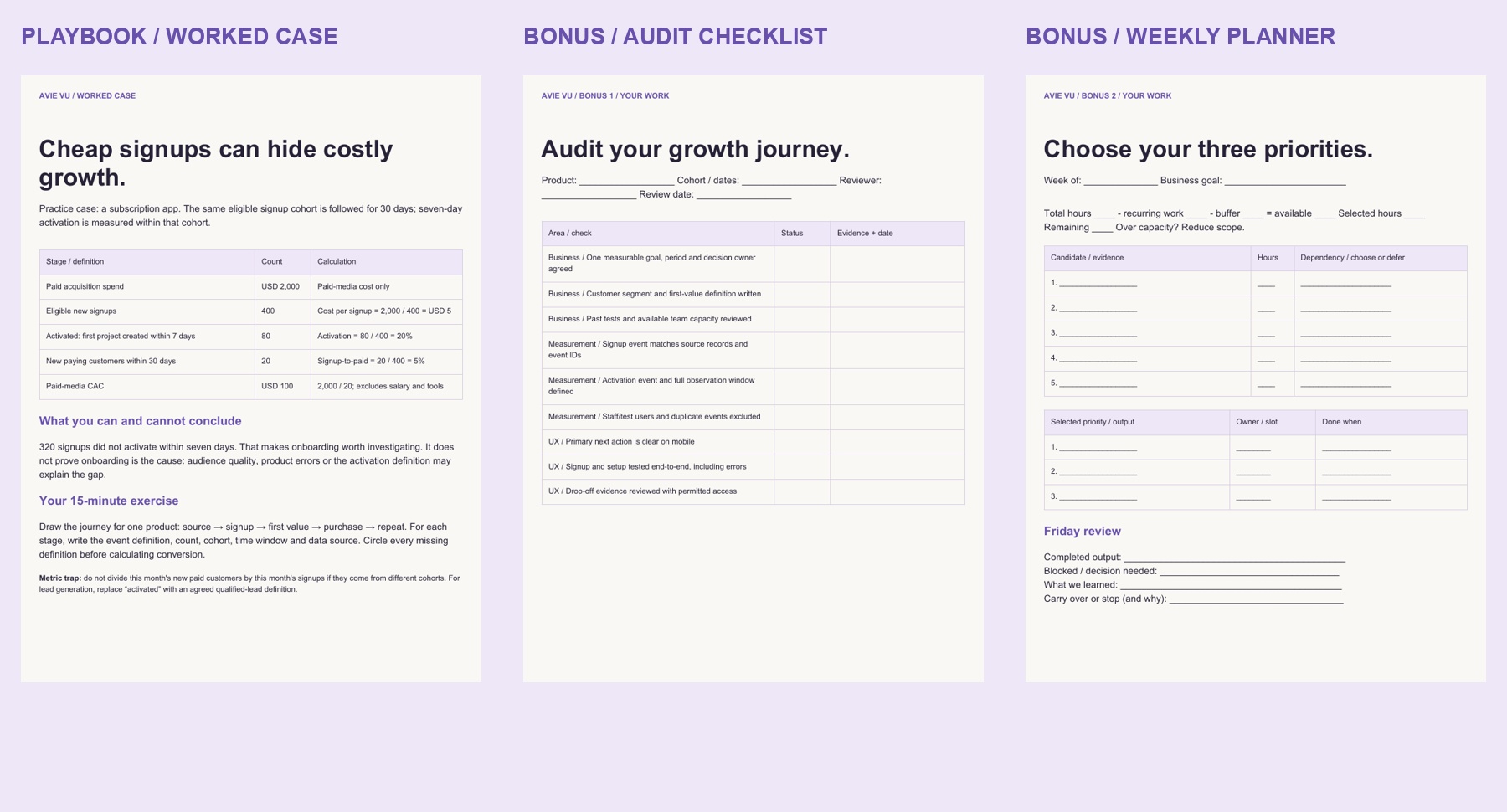
Choose a fictional subscription product. Spend 20 minutes mapping visit, signup, first value and payment. Spend another 20 minutes identifying missing evidence. Use 25 minutes to write one experiment with a target audience, primary outcome and guardrail. Use the final 25 minutes to prepare a weekly update.
Your finished document should contain a business goal, a funnel table, one supported priority and one decision request. If you cannot justify a priority, list the information you would collect first. That is a useful outcome too.
To make the exercise easier, get the free Remote Growth Manager Starter Kit. It contains a 10-page Arial guide, three editable core templates, a Growth Audit Checklist and a Weekly Priority Planner. Submit the form to download the ZIP; the page also offers an email copy for first-time requests.
How to assess a remote marketing role before investing in an application
A role can look attractive until you compare its responsibilities with the resources available. Read the description as an operating brief. What result will you own? Which parts of the journey can you influence? Who controls the product, creative production and commercial decisions?
If a role expects one person to own content, paid media, analytics, CRM and design, ask how priorities are chosen. A broad role can be a good fit when the scope is explicit. It becomes difficult when every channel is simultaneously treated as the top priority.
Use a short role-fit checklist
- Outcome: Can you explain the business result the role should improve?
- Scope: Are you expected to recommend, execute, coordinate or approve?
- Access: Will you have the data and tools needed to assess results?
- Dependencies: Who helps with engineering, creative work and customer feedback?
- Rhythm: Which meetings require live attendance, and which updates can be asynchronous?
- Location: Is your country explicitly eligible for this arrangement?
Do not treat an unanswered question as an automatic rejection. Use it to prepare a focused conversation. The goal is to discover whether the working arrangement lets you do the job well, rather than whether the company uses the right vocabulary.
Prepare evidence for the interview
Choose one project you can explain in five minutes. Start with the business objective, then describe the customer barrier, your contribution and the evidence. Finish with what you would change if you had another week. Bring a simple visual or table that supports the explanation.
If the project involved a team, name the boundaries of your work. You might have defined the audience and written the lifecycle brief while a developer implemented the events. That distinction makes the case more credible and helps the interviewer understand how you collaborate.
If you cannot share the underlying data, use an anonymized explanation only when permitted, or prepare a separate fictional example. Do not replace confidential figures with invented numbers and present the result as a real case study. Clearly distinguish your actual experience from the teaching example.
Demonstrate how you handle a blocker
Remote collaboration often becomes difficult when uncertainty remains invisible. Prepare an example of how you raised a dependency early: what was blocked, what impact it had, what alternatives existed and who could make the decision.
A concise message might say: “The campaign can launch on Tuesday if the conversion event passes validation on Monday. Otherwise, I recommend delaying the paid launch and continuing organic distribution. We need the developer’s test result by 3 p.m. to decide.” This makes the choice and deadline clear without blaming anyone.
Build a first-week plan that earns trust
Once you join a team, resist the pressure to propose a complete redesign immediately. Begin by understanding how the business currently defines success. Ask for the existing funnel, recent campaign reports, customer feedback and the team’s known constraints.
In your first two days, write down the definitions you hear. If marketing and sales mean different things by a qualified lead, make that disagreement visible. If two dashboards disagree, record the reporting windows and counting rules before deciding that either tool is wrong.
By the middle of the week, choose one customer journey to inspect end to end. Make a test account where appropriate, follow the onboarding steps and record points of confusion. Separate a confirmed issue from your personal preference. The team needs evidence it can assess.
Finish the week with a short readout: what you understand, which evidence is reliable, what is still unclear and what you recommend investigating next. Name the person needed for each dependency. This gives colleagues a useful way to correct your understanding before you commit resources.
For remote work in 2026, that combination of curiosity, clear writing and disciplined follow-through is a practical advantage you can build. It is also something you can demonstrate in a small practice project before you have the job.
Use your practice materials as working documents. Revisit the brief after feedback, improve a weak metric definition and explain why your priority changed. A polished first draft is less informative than a clear record of how you improve a decision when new evidence arrives.
Frequently asked questions
Do I need every analytics tool before applying?
No. Start with measurement principles, one tool you can use confidently and an example of a decision you made. Learn additional tools in the context of an actual business question.
Does remote always mean working from anywhere?
No. Check each role’s location and time-zone requirements. The word remote alone does not establish eligibility.
What should a business look for in a remote marketer?
Look for clear thinking, reliable delivery and the ability to connect campaigns to customer outcomes. If your team needs to clarify the problem and scope first, explore my 1-on-1 consulting and marketing audit services.
Editorial date: 8 October 2026. Conference information is sourced from WFH Research; the preparation advice is the author’s interpretation.