For businesses
Where is your next growth opportunity?
Find the friction between acquisition, activation and retention. Build a practical plan around your business goals.
Avie Vu / Growth marketing consultant · CRM · UX
As a growth marketing consultant, I help teams find where growth gets stuck, connect the customer journey, and turn business goals into focused experiments.
Strategy, lifecycle and conversion — connected to the outcome that matters.
Whether you’re growing a business or building your skills, start with a better question.
Find the friction between acquisition, activation and retention. Build a practical plan around your business goals.
Learn to read a funnel, choose useful metrics and turn an observation into an experiment.
Selected work / ZoltMoney
Localised acquisition, onboarding and lifecycle marketing for Vietnam and the Philippines.
Combined user base, reported 9 October 2026. My contribution spans organic growth, lifecycle marketing and market launches.
A company milestone, not an attribution claim or a promise of future results.
Ways to work together
Review the funnel, identify the most important bottleneck and decide what to test next.
Make onboarding, follow-up and reactivation useful, timely and measurable.
Connect priorities, experiments and reporting with ongoing hands-on growth support.
The Growth Audit / Editorial series
A series built around the questions behind the dashboard: who is dropping off, what is getting in their way, and what should we test?

Seven checks to find friction in your customer journey.
Show your thinking with an honest, practical portfolio.
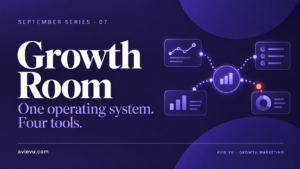
Connect PostHog, AppsFlyer, CleverTap and GA4.

Meet Avie
I bring an Accounting background and hands-on experience in marketing, CRM and UX to the same question: what would help the customer take the next useful step?
The way I work
Growth becomes easier to discuss when the team agrees what value looks like for the customer. A registered account, a first transfer and a repeat purchase describe different stages of a journey. Each needs its own questions, context and measurement.
As a growth marketing consultant, I look at the connection between the promise that attracts someone and the experience that follows. If acquisition, onboarding and lifecycle messages tell different stories, adding more activity can make the gap harder to understand.
The first step is to frame the decision. What outcome matters now? Which customers are included? What do we already know, and what are we assuming? Those questions shape the work before a channel or tool is chosen.
A change in a headline metric is a starting point for investigation. Customer mix, seasonality, tracking changes and operational issues may influence the result. A useful diagnosis considers those explanations before selecting a campaign or redesign.
The role of a growth marketing consultant is to make the reasoning clear enough for the team to discuss. Recommendations should state the evidence, the uncertainty and the next action. That makes it easier to challenge an assumption and improve the plan.
For an introduction to event-based measurement, see the official Google Analytics overview. The tool provides a way to collect information; the business question determines what is worth measuring.
A strategy is useful when people can act on it. The plan needs priorities, ownership and a realistic review rhythm. It also needs to reflect the team’s capacity, existing systems and dependencies across marketing, product and operations.
Working with a growth marketing consultant can help connect those conversations. The goal is a shared understanding of the customer problem and a focused sequence of actions, rather than a long list of disconnected ideas.
Some teams need a scoped audit before deciding what to do. Others need lifecycle improvements or ongoing support to coordinate the work. The services page explains these routes so you can choose a starting point that matches the actual need.
Experiments should have a clear hypothesis and a way to interpret the outcome. Not every test produces a reliable answer, and a short-term lift may not persist. Keep a record of the conditions, audience and limitations when reviewing what happened.
A growth marketing consultant should help the team learn from results, including results that do not support the original idea. That means changing the recommendation when evidence changes and separating a company milestone from an individual attribution claim.
A useful moment is when the team has a meaningful growth question but lacks a clear way to diagnose it or coordinate the response. You may be seeing acquisition without activation, disconnected lifecycle messages or a backlog of ideas without agreed priorities.
Begin with the problem and available evidence. If the next step is already obvious and fully owned by your team, a new engagement may add little value. If the uncertainty spans several parts of the customer journey, an outside review can help establish a common picture and a practical starting point.
No. Paid acquisition is one part of a broader journey. The work can include organic growth, onboarding, conversion, CRM, retention and the operating rhythm that connects them. The scope depends on the business goal, the evidence and the team that will implement changes.
A growth marketing consultant should not assume that more traffic is the answer. Sometimes the more useful question is whether the right audience understands the offer, reaches value or receives a relevant reason to return.
The Growth Audit editorial series shares analysis and questions that readers can apply to their own thinking. It is a learning resource. A paid Growth Audit is a separately scoped review of your business, its customer journey and the evidence available to your team.
Use the editorial page to explore the approach. Use Services if you want to discuss a project with a growth marketing consultant. We would agree the specific questions, data sources, deliverables and responsibilities before work begins.
Explain your product, priority audience and the outcome you want to improve. Include the main constraint and what you have already tried. A short description of the analytics and CRM tools you use can help frame a realistic discussion.
You do not need to send customer-level data or confidential records through the enquiry form. Start with enough context to understand the business question. If access to a system is needed later, its purpose and appropriate scope can be agreed as part of the project.
No responsible engagement can promise a fixed revenue increase or search position before understanding the business and execution conditions. Outcomes depend on the product, audience, market, data quality and the team’s ability to implement and learn.
What can be agreed is a clear scope, a useful decision process and a way to evaluate progress. Historical case studies provide context about previous work. They should not be treated as predictions for a different product or market.
The For Marketers page offers a roadmap, a free Starter Kit and guidance for building an honest portfolio case. Begin with one customer journey and practise explaining the problem, evidence, hypothesis and proposed next step.
You do not need to hire a growth marketing consultant to use those resources. The aim is to make practical growth thinking accessible and help you build the habit of connecting marketing activity with customer and business outcomes.
If you are considering a growth marketing consultant, bring one business question and a brief description of your current journey. We can use that context to discuss whether an audit, lifecycle project or ongoing support fits the need.