A useful growth marketing roadmap starts with a different question. Instead of asking, “What should I post or launch next?”, ask, “What stops the right customer from reaching value, and what evidence would help us improve that?”
You do not need to abandon your existing marketing skills. Content, paid media, SEO and CRM all give you a starting point. The next step is connecting that expertise to the wider customer journey and learning how to choose between competing priorities.
This growth marketing roadmap gives you a 30-day practice structure. It is a way to build evidence of your thinking, not a promise that one month of study makes someone ready for every Growth Manager role.
What changes when you move towards growth?
Channel work often begins with a specific output: publish an article, launch an ad or send an email. Growth work asks how that output contributes to acquisition, activation, retention or revenue, and whether it addresses the most useful problem now.
The roles overlap. A strong content marketer can already think this way, and a person with “growth” in their title can still operate as a campaign coordinator. The difference is visible in the questions, measurement and decisions.
| Starting point | Next growth question | Evidence to produce |
|---|---|---|
| Improve ad click-through rate | Do those clicks become qualified, activated users? | Acquisition cohort and activation comparison |
| Send onboarding emails | Which user state needs which next action? | Journey map with entry and exit rules |
| Publish search content | Which reader problem connects to a relevant product action? | Intent-to-action map and measurement plan |
The growth marketing roadmap: 7 practical steps
1. Choose one business model
Pick a product you can understand well enough to describe the buyer, the payment model and the reason someone returns. A learning subscription, a small online shop or a B2B service is sufficient.
Write a short growth brief: who the customer is, what problem the product solves, the current business objective and the constraints. Avoid beginning with a tool stack. You first need a problem worth measuring.
2. Define first value
A signup is an administrative milestone. First value is the moment the customer achieves something meaningful. For a learning product, that might be completing a useful first lesson; for a reporting tool, it could be creating a report that answers a real question.
Treat your activation definition as a hypothesis until you have evidence that it relates to continued use or payment. A growth marketing roadmap should teach you to improve definitions, not memorize one universal activation event.
3. Build a small funnel with clear denominators
Use one cohort, one observation window and explicit counting rules. “Thirty users paid” means little without knowing how many were eligible and how long they had to convert.
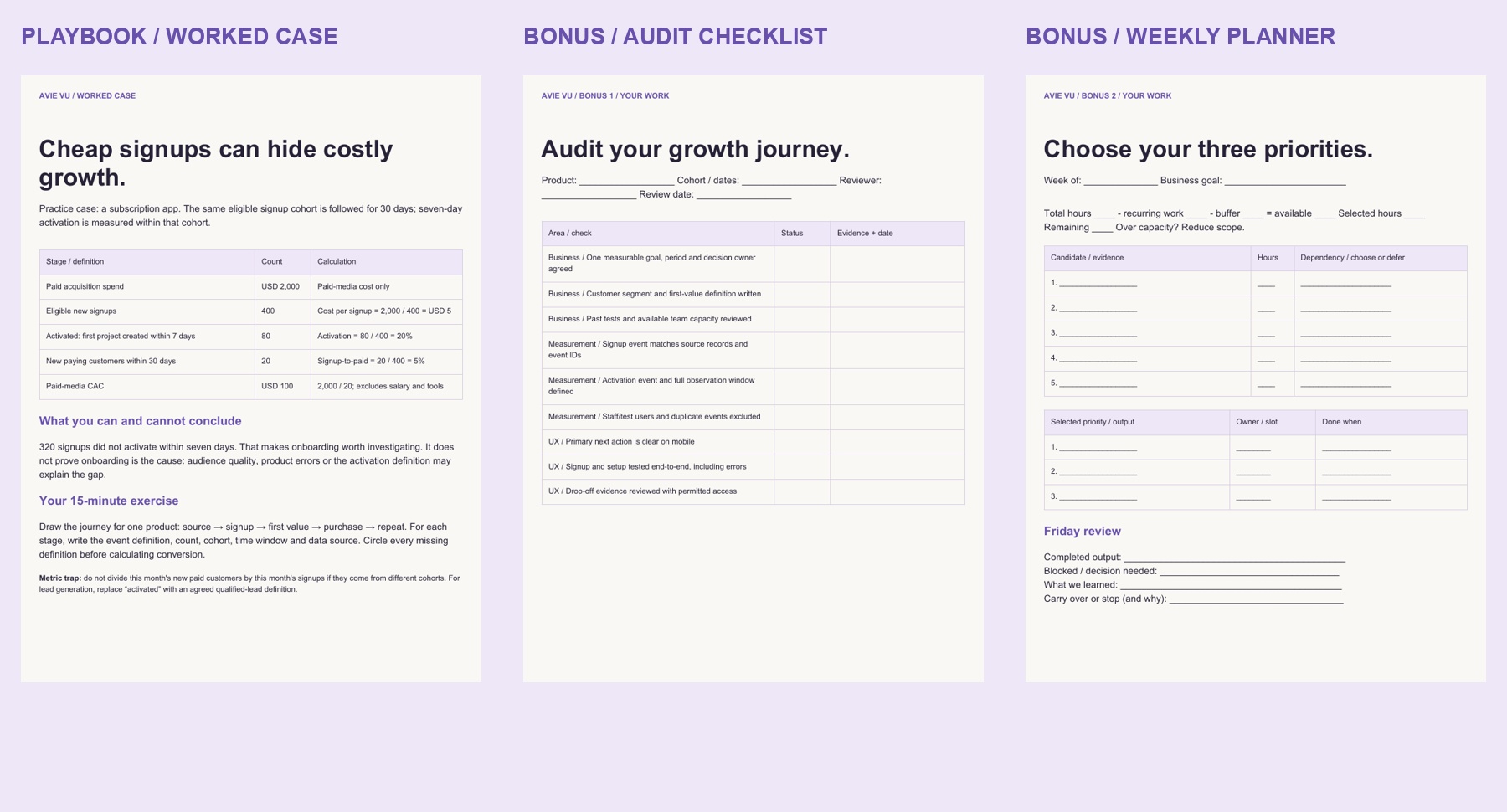
Consider this fictional practice case: $2,000 in media spend brings 400 signups, 80 reach first value and 20 become paying customers. Cost per signup is $5. Signup-to-first-value conversion is 20%. First-value-to-paid conversion is 25%. Paid-media customer acquisition cost is $100.
The $100 figure excludes salaries, software and other acquisition costs. Naming that boundary is part of doing the analysis properly. It also prevents a cheap signup from being mistaken for an efficient customer acquisition system.
4. Investigate before choosing a tactic
The largest percentage drop is a place to investigate, not automatic proof of the best opportunity. A step might intentionally filter unsuitable users. A segment may be small, expensive to improve or measured incorrectly.
Review the journey, customer questions and event quality. Ask whether the issue is low intent, unclear messaging, technical friction or a mismatch between the promise and the experience. The KYC drop-off diagnosis shows why another reminder cannot solve every incomplete journey.
5. Write one experiment that could change a decision
Use a simple structure: audience, observed problem, hypothesis, proposed change, primary outcome, guardrail and decision rule. “Test a better email” is too vague. “Test whether a clearer lesson entry link increases first-lesson completion among new trial users” is reviewable.
Choose a meaningful outcome rather than only opens or clicks. Decide how long users need to complete the action. If traffic is too low for a reliable randomized test, use interviews and a small usability study to reduce uncertainty, and avoid claiming that a before-and-after change proves causation.
6. Learn one analytics workflow and one lifecycle workflow
For analytics practice, learn to build a funnel, inspect a segment and explain the denominator. The PostHog funnel documentation is one primary reference for this workflow. You do not need to master four analytics tools simultaneously.
For lifecycle practice, write the rules for a welcome or activation journey: who enters, what they receive, when they leave and who must be excluded. For an example of the reasoning, read why lifecycle timing beats broadcast messaging.
7. Turn the work into a short case study
Organize the case around the decision. Explain the context, show the evidence, describe your hypothesis and state what you learned. If it is a simulated project, say so near the beginning.
The strongest growth marketing roadmap produces visible work: a brief, a funnel, an experiment record and a concise update. A certificate can support your learning, but these artifacts let someone assess how you reason.
Your 30-day growth marketing roadmap
| Week | Focus | Reviewable output |
|---|---|---|
| 1 | Understand the customer and business model | One-page growth brief and journey map |
| 2 | Define metrics and inspect the funnel | Funnel table, assumptions and three evidence gaps |
| 3 | Choose a priority and design a test | Experiment brief with outcome and guardrail |
| 4 | Review and communicate | Case study plus an asynchronous weekly update |
Adapt the pace to the evidence available. If measurement is unreliable, the right output for week three might be a tracking repair brief. Completing the calendar is less important than learning to make a defensible decision.
Put the growth marketing roadmap into practice
If you want a starting structure, download the free Remote Growth Manager Starter Kit through the request form. You will get a 10-page guide in Arial, three editable templates, a Growth Audit Checklist and a Weekly Priority Planner.
Start with the audit checklist to identify missing evidence. Use the planner to choose a manageable priority, then write the test in the Experiment Record. That sequence turns the growth marketing roadmap into work you can review with someone else.
If you already have a case but are unsure about the diagnosis, explore mentoring with feedback on your work and priorities. Bring a real question or a clearly labelled practice case so the discussion has something concrete to work on.
Frequently asked questions
Can a content marketer move into growth?
Yes. Audience understanding and messaging are valuable foundations. Build on them with funnel measurement, prioritization and evidence-based experimentation.
Do I need to code?
You do not need to become an engineer to begin. You do need to describe tracking requirements clearly and work with technical colleagues. SQL and technical skills can become useful as your responsibilities grow.
What if I do not have access to company data?
Use a fictional dataset and label it. Show the questions, definitions and calculations you would apply. Do not imply that public website observations reveal a company’s private performance.